


Cat DB - Catalytic Converters
D8ta Technologies LLC
When I first opened Cat DB - Catalytic Converters, I understood its purpose almost immediately: it is a business app for looking up catalytic converter prices by vehicle or by converter code. That narrow focus is its biggest advantage. Instead of treating the job like a general web search, I could approach it as a quick reference task, starting with the information I already had in front of me.
I can see the appeal for scrapyard workers, recyclers, mechanics, parts buyers, and anyone who regularly needs to identify a catalytic converter before deciding what to do with it. It is also useful for someone who has found a converter in a vehicle and wants a faster starting point than opening several browser tabs. The app is free to download, rated for Everyone, and developed by D8ta Technologies LLC. Its store presence shows a 4.5 average from around 180 ratings, with more than 10K installs, so it has found a practical audience without pretending to be a general automotive encyclopedia.
My overall impression is that this is a focused lookup tool rather than a complete workflow for buying, selling, dismantling, or documenting parts. That distinction matters. If your work begins with a vehicle or a code and ends with a price reference, Cat DB can save time. If you need full vehicle diagnostics, live market negotiation, shipping information, or a detailed inventory system, you will probably still need other tools beside it.
How I use the basic lookup workflow
The most sensible way to use the app is to begin with the strongest identification detail available. If I know the vehicle, I start there. If the converter has a readable code, I use that instead. This simple choice prevents a common mistake: searching with a vague description when a more precise identifier is already available.
A vehicle-based search is useful when the converter is still attached to the car or when I am checking a part based on the vehicle it came from. It gives me a practical route into the database without requiring me to recognize the converter visually. That is especially helpful when several parts look similar or when the exterior condition makes visual identification unreliable.
Related News

Why WhatsApp Messenger Still Makes Everyday Communication Feel Easy

Jurassic World: The Game Is the Better Dino Tycoon for Strategic Players

Threads in Real Life: Who Should Join, Lurk, or Leave

How SHEIN Turned Shopping Into an Endless Content Feed

How to Make Fortnite Feel Smarter on Mobile

Should You Switch to Microsoft Outlook on Mobile?
A code-based search makes more sense when the stamped or marked identifier is legible. In that situation, the code is usually more useful than color, shape, or a quick guess about the vehicle. I would clean the area enough to read the marking, enter it carefully, and check the result before treating the displayed price as a decision.
This is where I think the app fits into real work. Imagine I am sorting parts at the end of a shift and find a converter with a readable code. Rather than writing the code on a scrap of paper and searching later, I can look it up while the part is in my hand. I can then separate it from lower-priority items, record the result in my normal notes, and continue sorting. The app does not replace that record-keeping step, but it makes the first reference much quicker.
I would not treat the first result as an automatic offer or guaranteed payout. A database price is a reference point, while the actual amount can depend on the buyer, condition, location, verification, and the way the part is classified. The useful habit is to use Cat DB to establish a baseline, then confirm the details through the business or buyer handling the transaction.
Gallery
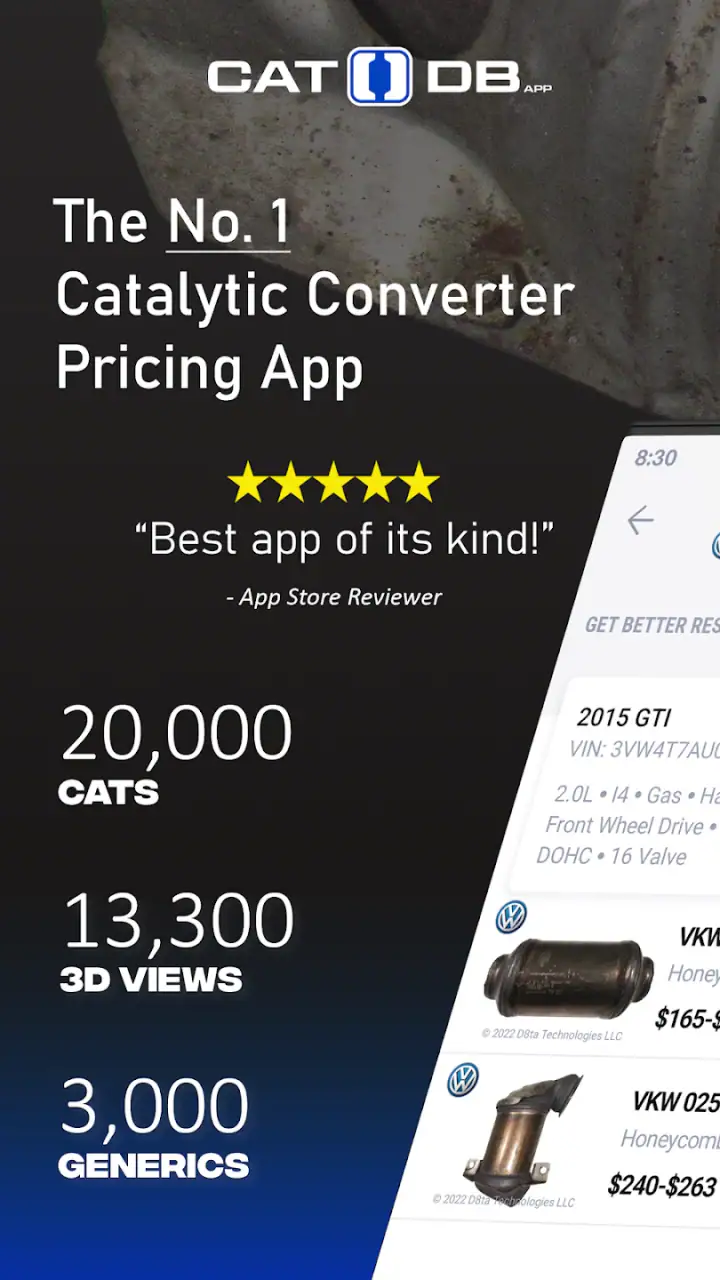
For vehicle searches, accuracy starts before the app. I would check the exact model information rather than relying on a broad family name, especially when similar vehicles can use different components. For code searches, I would double-check characters that are easy to confuse. A mistaken letter or digit can send the lookup in the wrong direction while still producing something that looks plausible.
That is one of the app's less obvious strengths: it encourages a repeatable identification habit. I do not have to begin every lookup by guessing what the part is worth. I can first ask which input is more reliable, vehicle or code, and then use the other information as a cross-check when available.
What I check before trusting a result
I would keep the physical part and the search result connected. If I am working with several converters, I label each one before moving to the next lookup. Otherwise, it is easy to remember a price but forget which code produced it. Cat DB is quick enough for repeated checks, but speed can create its own problem when multiple parts are lying on the same bench.
Another useful habit is to photograph or write down the code before searching. The app is not a substitute for evidence. A clear record lets me revisit a result, compare it with a buyer's assessment, or explain how I reached a preliminary valuation. This is particularly important when the converter is being handled by more than one person.
I also separate identification from negotiation. First I use the app to find the relevant reference. Then I consider condition and the transaction itself. Mixing those steps can lead to disappointment because the number in a database is not necessarily the amount someone will pay for a damaged, contaminated, incomplete, or unverified part.
Settings and routine choices that are actually worth checking
Cat DB is not the kind of app where I expect a long configuration process. Its value comes from getting to the lookup quickly. Still, I would check the app's available settings and the device permissions during setup, because a business reference tool should not interrupt a work session with avoidable surprises. I would also make sure the app is updated when an update is available; the current version is 1.26, and keeping a lookup tool current is a sensible maintenance habit.
The most important “setting” is really the way I organize my searches. I prefer to decide in advance whether a job is vehicle-led or code-led. If I am processing a list of vehicles, I keep the vehicle information together and work through it consistently. If I am sorting loose converters, I use the readable code as the starting point and avoid switching back and forth without noting which part I am handling.
Because the app is free to install but includes in-app purchases ranging from $1.99 to $289.99 per item, I would pay attention to any purchase screen before confirming it. That does not make the app unsuitable, but it does make it worth understanding which functions are available without payment and which, if any, require an optional purchase. I would not assume that every lookup or advanced capability follows the same access model simply because the initial download costs nothing.
This is also why I would avoid handing the phone to a casual helper without explaining the workflow. Someone unfamiliar with the app might tap through a purchase prompt or enter incomplete information just to get a result. In a workplace, a clear rule helps: identify the part, choose the correct search route, review the result, and record the reference before moving on.
For a personal phone, I would keep a simple note template ready outside the app. The template could include the part label, vehicle or code used, date of the lookup, and the result I found. I am not claiming Cat DB provides that template; this is a complementary habit that makes the app more useful. It turns a one-time search into traceable information.
The Everyone content rating is reassuring for shared devices and mixed-age environments, but it should not be confused with professional completeness. A general audience can open the app, yet the person interpreting a price still needs basic judgment about vehicle identification, part condition, and the difference between a reference value and a final transaction.
Faster patterns for repeated work
Experienced users will get more from Cat DB by reducing unnecessary decisions. My preferred pattern is to prepare the input first, perform one clean lookup, record the result immediately, and only then move to the next part. Repeating that sequence is faster and safer than opening the app repeatedly while trying to remember several codes.
When I have both a vehicle and a code, I treat them as two ways to validate the same job rather than two unrelated searches. I start with the clearer identifier and use the second one if the result seems unexpected or if I need more confidence before discussing the part with someone else. This cross-checking habit is more valuable than simply searching every possible variation.
For a batch of parts, I would sort them into three groups: clearly identified, needing a cleaner code or better vehicle information, and uncertain. Cat DB is most efficient with the first group. The second group needs preparation, such as cleaning the marking or checking the vehicle details. The third group should not be forced through the app with guesses. A fast incorrect lookup is still wasted time.
Another practical shortcut is to make the app part of the intake process rather than an afterthought. When a converter arrives, I can assign it a temporary label, capture the identifying information, perform the lookup, and store the reference beside that label. This avoids the common end-of-day pile of unidentified parts and reduces the chance that two similar converters become mixed together.
I would also use a stable naming pattern in my notes. For example, I might keep the physical label first, followed by the search method and identifier. The exact format is up to the user, but consistency matters more than complexity. Cat DB supplies the lookup; the surrounding habit supplies the memory and organization.
Compared with searching the open web, this approach feels more focused. A normal search may return forum posts, advertisements, unrelated vehicle pages, or old discussions before I reach a useful reference. Cat DB is designed around the specific converter-price question, so it removes some of that browsing. The trade-off is that a general search engine can provide broader context, seller contact details, technical explanations, and alternative sources that this focused app is not designed to replace.
Compared with a spreadsheet, Cat DB is better for immediate reference and worse for long-term tracking. A spreadsheet can hold purchase dates, seller names, quantities, notes, and outcomes in one place. The app is more convenient when I need to look up a vehicle or code right now. For serious inventory work, I would use both: Cat DB for identification and price reference, and a separate record for business history.
Compared with asking a buyer directly, the app gives me a preliminary point of reference before I start the conversation. That can make a discussion more informed, but it should not be used to challenge a final offer without checking whether both sides are talking about the same converter and condition. The app helps me ask better questions; it does not settle every commercial disagreement.
Where the app reaches its limits
The focused design that makes Cat DB convenient also defines its boundaries. I would not install it expecting a repair manual, emissions diagnostic tool, vehicle maintenance planner, or full recycling-management platform. Its job is much narrower: connect a vehicle or converter code with a price lookup.
That narrow purpose means the quality of my result depends heavily on the quality of my input. A damaged marking, incomplete code, incorrect vehicle detail, or assumption based on appearance can undermine the lookup. The app cannot compensate for an identification error that I introduce before searching.
I also would not use a displayed figure as proof of ownership, legality, condition, or provenance. Those questions belong to the transaction and the relevant local requirements, not to a price-reference lookup. If a converter comes from an uncertain source, the responsible step is to resolve that issue separately rather than relying on a database result to make the situation acceptable.
There is a practical limitation in relying on a specialized database: I still need a backup plan when the exact part is difficult to identify. That may mean consulting manufacturer information, asking an experienced buyer, checking a physical marking again, or using a broader automotive resource. Cat DB is most valuable when it is one dependable step in a larger process, not when it is expected to answer every question about a converter.
The purchase structure is another point I would approach carefully. Since optional items can range from a small charge to a much larger one, I would review the wording of each purchase before proceeding and make sure the account holder understands the cost. For a business device, I would establish who is authorized to buy anything. For occasional personal use, I would first test whether the free portion already covers the lookups I need.
The app's release date is Apr 24, 2023, which places it in a relatively recent generation of mobile tools, but that alone does not tell me how well every individual record matches today's market. Prices in recycling and parts markets can change, and different buyers may apply different grading rules. I would therefore use the app as a current starting reference while keeping the final decision grounded in a fresh conversation with the actual buyer.
Users who only need a single lookup may find a browser search or a direct call more convenient, especially if they already know a trusted buyer. Someone managing hundreds of parts may prefer specialized inventory software with scanning, user accounts, reports, and transaction history. Cat DB is better suited to the middle ground: repeated, focused lookups without the overhead of a complete business system.
Who should use it every day
I think Cat DB is a good match for people who repeatedly handle catalytic converters and need a quick reference during sorting or intake. Recyclers can use it to prioritize parts for closer review. Mechanics can use it when a converter code needs a preliminary value check. Small operators can use it before contacting a buyer, provided they keep their own records and do not confuse the lookup with a guaranteed quote.
It can also help a newcomer learn a disciplined process. Rather than guessing from shape or assuming that every converter from one vehicle has the same value, the user learns to identify the vehicle or code, search carefully, record the result, and verify the commercial details separately. That is a modest workflow, but it is much safer than relying on memory.
I would skip it if my main need is vehicle repair information, emissions troubleshooting, parts compatibility, or a complete sales ledger. I would also skip it if I only expect to perform one search and already have a reliable local source. An app earns its place on my phone when it solves a recurring problem more conveniently than the alternatives, and this one is most convincing for recurring converter lookups.
For privacy-conscious users, the sensible approach is to review the app's permission requests on the device and provide only what is needed for the workflow. I would not assume that a price lookup requires access to unrelated phone functions. Keeping the app's role narrow also makes it easier to decide whether it belongs on a personal phone, a shared work device, or a dedicated business handset.
My verdict after building a repeatable habit
After using Cat DB as a focused reference rather than expecting it to be a complete automotive platform, I find its value easy to understand. It shortens the path from a vehicle or code to a preliminary price reference, and that is exactly the task it is built around. The best results come from pairing it with careful identification, immediate note-taking, and a separate check of the actual buyer's terms.
I like that the app can fit into several levels of work. A casual user can perform a quick search. A mechanic can use it during intake. A recycler can build a repeatable batch process around it. The more organized the surrounding habit, the more useful the app becomes. Its strength is not flashy complexity; it is the reduction of friction in a specific business task.
At the same time, I would keep my expectations realistic. It does not remove the need to verify codes, inspect parts, compare commercial offers, or maintain records. The optional purchase range also deserves attention before anyone spends money. Those are not reasons to dismiss it, but they are reasons to use it deliberately.
The app is free to download, supports devices running Android 7.0 or later, and carries an Everyone rating. For someone who handles catalytic converters often, those practical details make it easy to try without a large commitment. My recommendation is straightforward: use Cat DB when you need a specialized lookup, but make your own identification and documentation habits part of the process. It works best as a fast reference inside a careful workflow, not as the final authority on a transaction.
FAQs for Cat DB - Catalytic Converters
What is Cat DB - Catalytic Converters used for?
Cat DB - Catalytic Converters is designed as a reference tool for identifying and researching catalytic converters. It can help users compare converter information, look up possible matches, and organize details that may be useful when evaluating automotive parts. It is particularly relevant to mechanics, recyclers, dismantlers, parts dealers, and vehicle owners who need a convenient database while working away from a desktop computer.
Does Cat DB include information for every catalytic converter or vehicle?
No database can guarantee complete coverage of every converter, vehicle, manufacturer, or regional part number. Cat DB may contain a substantial collection of listings, but availability and accuracy can depend on the catalog version, updates, and the information supplied by its sources. Users should treat search results as a helpful reference and confirm important details with the physical part, vehicle documentation, or a qualified automotive professional.
Can I use Cat DB to identify a catalytic converter from a photograph or part number?
The app’s usefulness depends on the identification details it supports, such as catalog numbers, manufacturer references, vehicle information, or other searchable characteristics. If a photo-search feature is not available, you may need to read markings from the converter and enter them manually. Before relying on a result, compare its shape, markings, dimensions, and vehicle compatibility with the actual component.
Is Cat DB - Catalytic Converters free to download and use?
The download and available features may vary between the Android and iOS versions, and some functions could require payment, registration, or an in-app purchase. Check the official store listing on your device for the current price, subscription information, supported operating system, and any limitations. Reviewing those details before installation is recommended, especially if you only need occasional catalog lookups.
Can the app determine the exact value or recycling price of a catalytic converter?
Cat DB may provide identification or reference information, but users should not assume that an app result represents a guaranteed purchase price. Recycling values can change frequently according to precious-metal markets, converter condition, location, buyer policies, and local regulations. Use the app as a research aid, then request a current quote from a reputable recycler and verify ownership requirements before selling any part.
Pros
- Quickly identifies catalytic converters by vehicle make
- model
- and year.
- Useful reference for mechanics
- recyclers
- and automotive parts buyers.
- Helps compare converter details before purchasing or dismantling parts.
- Compact database is convenient to consult while working in the garage.
- Can support faster estimates when checking potentially valuable converters.
Cons
- Coverage may vary for uncommon vehicles or older model years.
- Database information may require updates as converter prices change.
- Some entries may need verification against the converter’s physical markings.
- Not a replacement for local recycling prices or professional valuation.
- The app’s usefulness is limited if your vehicle is not included in its database.


